Many of the learners who arrive at Bidwell Training Center in greater Pittsburgh have already tried postsecondary education. The average student is 30 years old, often carrying student loan debt from an experience that didn’t lead where they hoped. Bidwell’s tuition-free programs, spanning allied health, chemical lab technology, plant science technology, culinary arts, medical billing, medical assisting, and institutional pharmacy technology, offer Pennsylvania residents with a GED or high school diploma a direct path into skilled careers.
Bidwell occupies a distinct place in Pittsburgh’s education landscape. It isn’t a six-week bootcamp, and it isn’t a traditional university. Licensed by the Department of Education and conferring true postsecondary credentials, it sits in a category of its own, one built entirely around a single outcome. “Everything we do is employer driven and outcomes based,” says Kelly Weiler of Bidwell. “We take input from the employers, and the only positive outcome is getting our students a job. Graduation is step one, but it’s not complete.”
That distinction, between graduating and actually being ready to work, is what led Bidwell to build something most schools never formalize. “We say we get people work ready,” says Vice President Kim Rassau, “but how do we really measure this?” The answer became a school-wide framework for developing, tracking, and coaching the skills that live outside a technical syllabus.
Three Skill Sets, Equally Valued
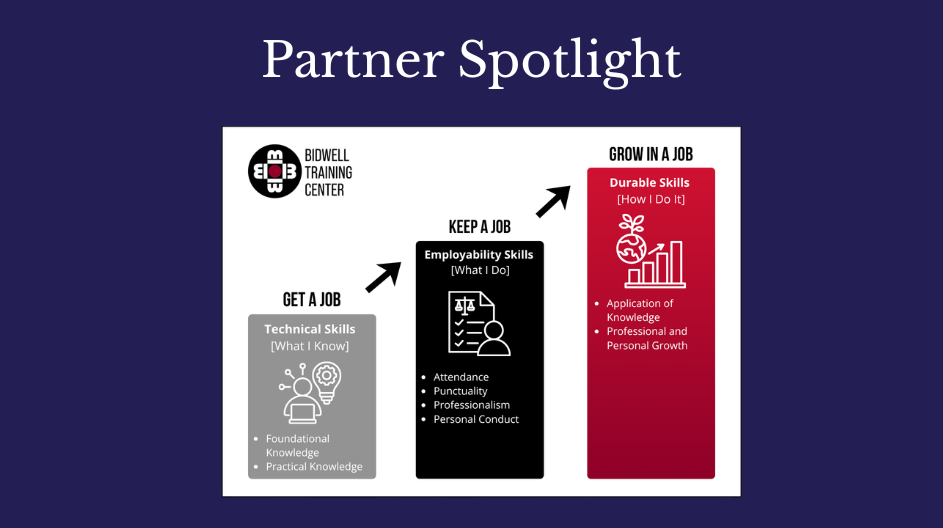
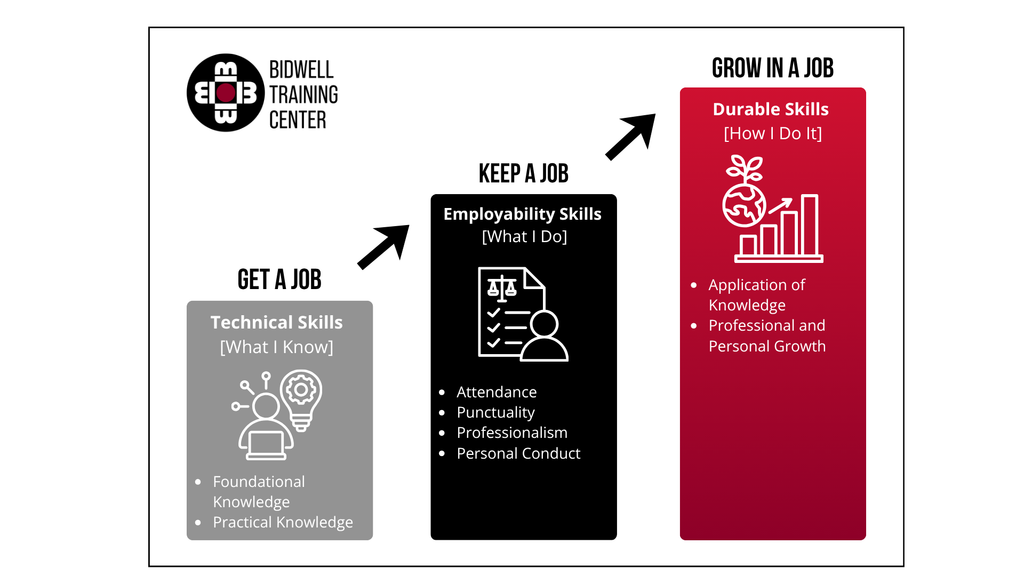
Bidwell organizes student development around three categories of skill, each treated as equally critical to success:
- Technical skills, the hands-on competencies specific to each program, whether that’s chemical lab procedures, culinary technique, or pharmacy compounding.
- Employability skills, the fundamentals of showing up and performing reliably, like attendance and punctuality.
- Durable skills, the human capabilities that determine whether someone can keep a job and advance in it.
This holistic focus reflects something Bidwell’s staff realized quickly: because incoming students carry such varied educational and employment histories, durable and employability skills need the same intentional leveling that a math class gives students with different academic backgrounds. Building all three into the success criteria, not just the technical one, is what drives Bidwell’s actual goal: getting graduates hired, and keeping them employed.
Building with the Pathsmith® Framework
Bidwell used the Pathsmith® Framework Starter Edition to build a school-wide curriculum, assessment approach, and toolkit around durable skills. The work anchors around two categories of skill development:
- Professional growth skills: communication, creativity, critical thinking, collaboration, and metacognition.
- Personal growth skills: character, leadership, mindfulness, growth mindset, and fortitude.
Bidwell’s technical instructors, not just its career services staff, are responsible for weaving durable skills directly into their coursework. In the chemical lab technology program, that shows up as a sequence of presentations that escalates in complexity across the year.
In the first quarter, students create a short collaborative video connecting a chemistry concept to everyday life, built to mimic the kind of quick, clear update a boss might ask for on their way to a meeting. That brings in collaboration and creativity. By the second quarter, students design and run a small experiment, then present it to a different program’s students entirely. One recent student presented a project on coffee and acidity, walking horticulture students through the plant compounds behind different brewing methods and flavor profiles, a task that draws directly on metacognition: planning the experiment, adjusting the message for an unfamiliar audience, and reflecting on the process itself.
Instructors are also deliberate about vocabulary. “Instead of teamwork, let’s call it collaboration,” Kelly explains. The goal isn’t to add new work to an already full curriculum, but to name what’s already happening with more precision. As Kelly puts it: “It’s not about how can I incorporate the biggest number of durable skills, but how can I do small steps intentionally.” A simple math worksheet becomes an opportunity for durable skills practice just by asking a student to explain their thinking to the class, no rewritten lesson plan required.
Personal growth skills, meanwhile, live in a dedicated professional development course every student takes for the full length of their enrollment, moving from career exploration early on to resumes, cover letters, and interview preparation as students approach externship and placement. Within that course, students use a self-assessment to identify one specific skill to work on, then practice it through a structured habit over each quarter, turning in weekly reflections. Faculty grade the quality of the effort and the reflection itself, not whether the underlying skill visibly improved.
Kim is candid that getting instructors on board took real work. “It’s not always necessarily adding more work,” she says. “It’s being mindful of how you’re doing your work.” Once faculty saw it that way, durable skills stopped feeling like an add-on and started functioning as a real, embedded part of how programs like allied health prepare students. As she shared: “If you’re a medical assistant student, your durable skills development is just as important in your clinical classes as your ability to successfully do a venipuncture.”
Skills Self-Assessment and Development
One of the more distinctive pieces of Bidwell’s approach is a durable skills self-assessment given early in a student’s time at the program. Students use it to reflect on their own development across durable, technical, and employability skills throughout their time at Bidwell, not as a one-time checkpoint, but as an ongoing practice.
That process has produced some clear stories of growth. One student came in as an introvert, uncomfortable with self-promotion, and used the self-assessment to target growth mindset specifically. “I don’t like doing it,” he told staff. “But I’m going to do it anyway.” Each time got a little easier. By the end of the program, he was one of the strongest students in his class.
Perhaps the most striking example came from a single mother in the allied health program. In a difficult moment with her young daughter, she caught herself before reacting automatically. “I stopped myself and thought, no, that’s not what we learned about durable skills,” she said, and chose a different, more intentional response instead. For Kim, that moment, a skill built in the classroom showing up in someone’s personal life, was “a complete and total win.”
What’s Next
Bidwell is building toward a more complete picture of student development over time. The team is working on a dashboard that would track students from intake through graduation and five years beyond, folding in things like employer feedback, graduation surveys, and alumni feedback alongside their skills data. They’re also exploring whether the durable skills self-assessment could help gauge program fit at the point of admission, flagging when the gap between where a student is and where they need to be might be too large.
They are also moving toward applying the same self-assessment and quarterly tracking approach to faculty themselves, giving instructors their own durable skills goals alongside their technical and classroom management development. As Kelly and Kim see it, that isn’t just useful for staff growth. It models something powerful for students, showing them that the adults around them are working on the same kinds of skills, too.
What ties all of it together, the classroom presentations, the self-assessments, and the evolving dashboard, is a belief that durable skills aren’t a supplement to technical training but a condition of it. Bidwell built the infrastructure to prove that belief out, one cohort, one presentation, and one reflection at a time.