In 2024, with support from Trellis Foundation, America Succeeds launched a national Community of Practice (CoP) to explore how community colleges can more effectively integrate durable skills into continuing education (CE) programs. The goal was simple but ambitious: learn alongside colleges about what it truly takes to embed skills like communication, collaboration, problem solving, and professionalism into the most employer-connected part of the postsecondary ecosystem.
Phase I: Naming the Barriers
Over the course of Phase I, the CoP brought together 12 colleges from 7 states representing diverse student populations, labor markets, and program structures. Through surveys, convenings, and conversations with faculty and industry partners, a set of shared challenges quickly came into focus: limited institutional buy-in, few professional development opportunities (especially for adjunct faculty), a lack of ready-to-use teaching materials, and no scalable tools for assessment or credentialing. At the same time, colleges expressed strong demand for flexible, affordable resources that could be implemented without overburdening faculty or institutions.
Phase II Kickoff: Building Solutions Together
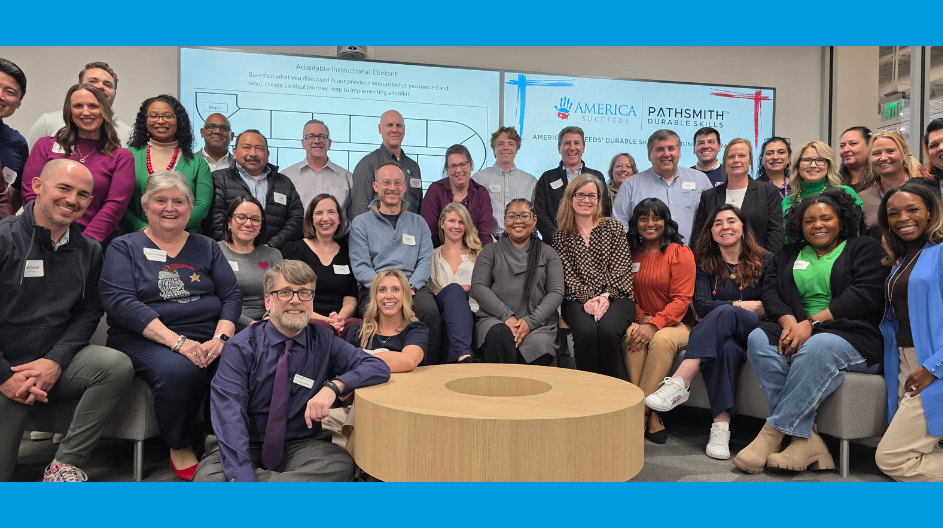
To launch Phase II, we convened community college leaders and solution providers in Austin, Texas, in December. The convening was grounded in a shared commitment to co-design solutions and strategies, intentionally bringing the end users’ voice to the forefront of ed tech development. Through facilitated working sessions led by Education Design Lab, participants engaged in candid, practical problem-solving about how durable skills can be integrated into CE programs in ways that align with employer needs while remaining feasible to implement at scale.
One theme surfaced again and again: durable skills integration cannot be solved with a single tool. Instruction, reflection, assessment, credentials, and faculty learning must work together as a coherent ecosystem. None of these components alone is sufficient. Together, they create the conditions for durable skills development to become a norm rather than an exception in continuing education.
What Comes Next
Guided by this insight, our Phase II work will focus on piloting a connected set of tools and supports that colleges can use together, including implementation toolkits, faculty professional learning, adaptable teaching content, and assessment and demonstration tools for learners. While this phase centers on CE programs, the solutions are designed to be adaptable across certificate, associate, and transfer pathways.
Community colleges are uniquely positioned to lead this work, particularly for low-income learners and communities of color who rely on continuing education as a pathway to economic mobility. The momentum from the December convening reaffirmed both the promise and urgency of this effort. With deeper investment, we can broaden experimentation, engage more faculty and learners, and generate stronger insights into what it takes to integrate durable skills at scale.
If you are interested in learning more about this work or supporting the funding of Phase II, please contact Aidan Schief.