Educators across the country know durable skills matter. So do employers. At this point, the challenge isn’t awareness; it’s infrastructure. What does intentional skill development look like in a prekindergarten classroom? In fifth grade? In twelfth? And how does that work connect to what’s actually expected on the job?
The Pathsmith™ PK-16 Durable Skills Developmental Progression was built to answer those questions. It extends the Pathsmith™ Durable Skills Framework across the full continuum of learning from early childhood through the end of high school, laddering up to our existing early career resources and rubric.
Our enhanced Pathsmith™ offering now provides something the field has been missing: a connected system from early childhood development through real-world performance in the workforce.
What the PK-16 Developmental Progression Includes
The PK-16 progression is designed to make durable skills visible and actionable across learning environments. It includes:
- 24 durable skills organized into four clusters
- Research-informed descriptions for each skill
- 360 behavioral indicators across five developmental levels
- A progression grounded in learning science and human development
- A crosswalk to the Pathsmith™ Early Career Rubric, showing how developmental skills build toward employer-defined expectations
This is not just a framework for naming skills. It’s a tool for understanding how they grow.
Why This Matters Now
Our research with Lightcast shows that 8 of the top 10 most requested skills in job postings are durable skills. These competencies are consistently valued across industries, roles, and regions and do not expire when industries shift or technologies change. But building them requires intention, and intention requires a shared language, clear expectations, and tools educators can actually use. Our Pathsmith™ suite of tools now spans the full continuum, from a child’s earliest learning environments to their first years in the workforce.
Built With the Field
This work didn’t happen in isolation. It was developed through a multi-phase process that brought together research, practice, and real-world testing. We started with a comprehensive review of learning science and human development research. From there, national experts helped refine the structure and language. Hundreds of educators across classrooms, afterschool programs, and youth-serving organizations then piloted early versions, providing feedback that shaped the final progression. One of the most important shifts to come out of that process was expanding from K-12 to PK-16. The result is a model that better reflects how skills actually develop across the full learner journey.
What’s Included in Pathsmith™ Today
With this expansion, Pathsmith™ now serves as an umbrella framework for durable skills across the continuum. It includes:
- PK-16 Developmental Progression
- Early Career Performance Rubric
- Durable Skills Lexicon
- Crosswalks connecting development to workforce expectations
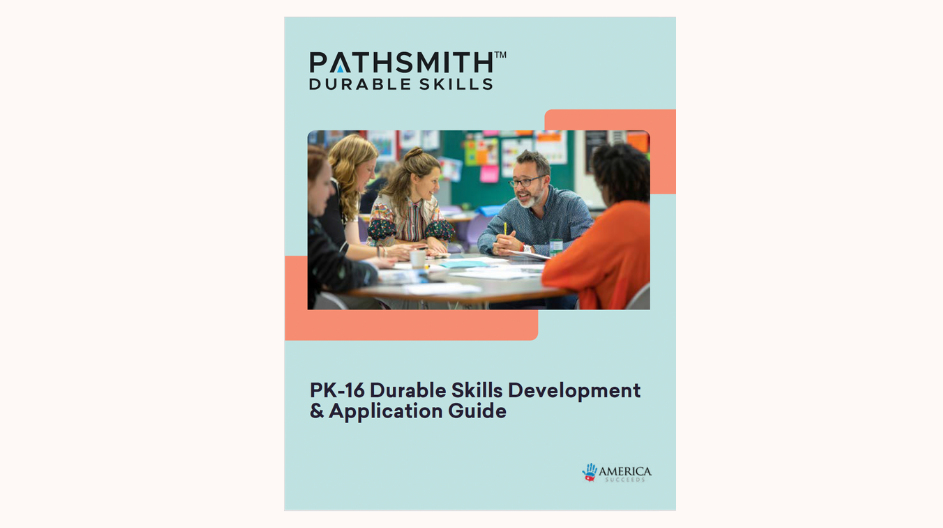
- Development and Application Guide
- Starter and Full Editions of the early career framework
All components are available through a single Pathsmith™ license, designed for partners embedding durable skills into curriculum, assessments, programs, and systems.
For the broader field, we are making select resources publicly available, including the Development and Application Guide, which provides educators with practical entry points for implementation and crosswalks that connect development to workforce expectations.
The Bigger Picture
This expansion reflects a simple idea: durable skills don’t start in high school, and they don’t end at graduation. They are built over time, show up across contexts, and they matter most when they can be clearly defined, intentionally developed, and credibly communicated.
Our Pathsmith™ suite of tools now defines that full continuum, from early development to early career; moving with learners as they journey from aspiration to application.