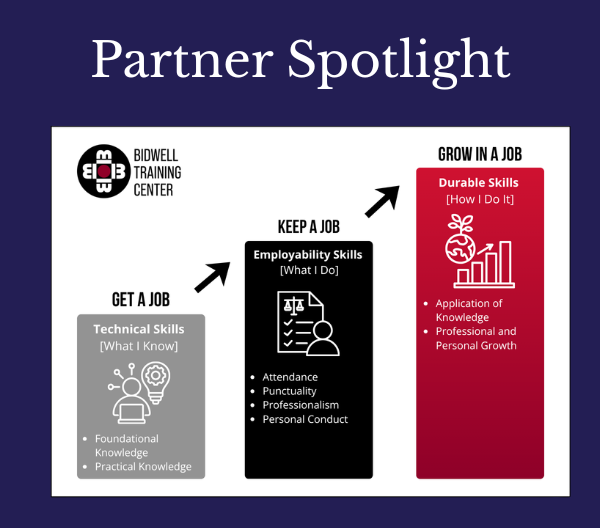

The Beyond the Portrait policy scan examined 22 enabling conditions across six categories to understand how states are building the infrastructure for academic, durable, and technical skills development. One of the report’s core findings is that no single enabling condition transforms learning on its own. What matters is whether conditions compound on one another across categories to form a coherent system. Applied learning is one area where this is especially visible. States must set the expectation that students participate in applied learning opportunities in high school. Then, states must create funding streams for those applied learning opportunities to expand access and improve quality. Finally, states must use accountability indicators that incentivize those experiences and recognize the outcomes they produce.
When conditions reinforce each other, states create an infrastructure of possibility. One of the most consequential places where that coherence breaks down is the gap between what states expect students to do and how states fund the infrastructure to make it possible.
The Gap
Across the country, states are building graduation pathways, CCR demonstration options, and accountability indicators that depend on students completing applied learning opportunities. Work-based learning is increasingly embedded in those expectations, whether as a graduation requirement, a pathway to an advanced diploma, or a component of how a state measures college and career readiness. That growing demand reflects a recognition that career-connected experiences are central to preparing students for life after high school.
But work-based learning is the applied learning opportunity that requires the most infrastructure to deliver. It depends on employer partnerships, coordination between schools and workplaces, transportation, liability coverage, supervision, and scheduling flexibility. Unlike dual enrollment, which can be scaled through agreements with postsecondary institutions, WBL requires a web of local relationships and logistical support that districts cannot build on their own without dedicated resources.
When a state builds the expectation for WBL into its graduation system or accountability framework without building the funding infrastructure to support it, the result is a coherence gap. The mandate exists. The capacity to meet it does not follow automatically.
And the gap does not affect all students equally. Districts in rural communities without a concentration of nearby employers face a fundamentally different challenge than suburban districts with robust industry partnerships. Small districts without dedicated CTE coordinators or WBL staff lack the capacity to broker and manage placements. Students who cannot arrange transportation to a worksite face a barrier that no graduation requirement can remove on its own. When expectations outrun funding, the students in the least-resourced communities are the most likely to be left without access to the experiences their state’s own system expects them to complete.
Where the Gap Shows Up
Oklahoma is building significant new expectations for applied learning. HB 3278 (2024) established that beginning with students entering eighth grade in the 2025-2026 school year, graduates must complete six pathway units aligned with their Individual Career and Academic Plan, which may include internships, apprenticeships, CTE courses, and concurrent enrollment. The state’s 2030 graduation requirements also mandate that students participate in service learning or work-based learning activities at least once during grades 9-12. On the accountability side, Oklahoma’s Postsecondary Opportunities indicator measures completion of all applied learning opportunity types.
These are meaningful structural signals that applied learning matters. But Oklahoma’s CTE funding model does not create the same kind of targeted incentive at the district level. The state does not use an additional per-pupil or categorical funding weight for CTE students. Instead, it appropriates a lump sum to the Oklahoma Department of Career and Technology Education, which operates CTE programming and disburses funds to schools and area career technology centers. This is not an absence of CTE investment. Nearly $200 million flows through that department annually. But the funding architecture does not compound with the requirements architecture. A district looking at the new graduation expectations does not see a corresponding per-pupil funding stream or competitive grant that says: here is how you build WBL capacity to meet this expectation. The money and the mandates exist in parallel rather than reinforcing each other.
Nevada tells a similar story through a different mechanism. The state has built an ambitious yet optional College and Career Ready Diploma that requires students to earn a 3.25 GPA, demonstrate proficiency in two or more languages, and complete two units of credit in an applied learning opportunity or in AP/IB coursework. Multiple diploma pathways and state seals create further expectations around career-connected learning. Nevada’s accountability formula includes a CCR indicator that measures both participation and completion in dual enrollment, CTE, and industry-recognized credential attainment.
But on the funding side, WBL support comes primarily through general CTE allocation and competitive grants, with work-based learning listed as one of many allowable uses of those funds rather than as a dedicated investment. There are no state-funded employer incentives for WBL participation. Nevada built a system that asks students to complete applied learning to earn its most distinguished diploma and holds districts accountable for those outcomes, but the targeted funding to support WBL coordination, employer engagement, and student access has not kept pace with those expectations.
What Alignment Looks Like
Tennessee offers an example of what it looks like when funding is designed to reinforce what the graduation and accountability systems expect. The Tennessee Investment in Student Achievement (TISA) formula provides direct allocations for students enrolled in CTE programs of study, and layers on top of those allocations an outcomes funding component that rewards districts when students achieve postsecondary readiness targets. The outcomes funding is 100% state-funded. At the high school level, districts earn bonus payments for each student who completes early postsecondary opportunities such as dual enrollment coursework, industry credentials, or qualifying AP and IB exams. For the 2024-25 school year, that bonus was $707.50 per eligible student, and it doubled to $1,415 for students identified as economically disadvantaged, English learners, or students with disabilities. Statewide, Tennessee distributed over $82 million in outcomes funding in 2024-25. That equity-weighted design ensures the funding incentive is strongest where the need is greatest.
Tennessee also funds the employer side. Established in TN Code § 49-11-904 (2024), the state administers work-based learning grants that reimburse employers for costs associated with providing WBL opportunities, with awards of up to $5,000 per year. WBL counts for both course credit and graduation pathways. The state’s Ready Graduate accountability indicator measures completion of applied learning opportunities including dual enrollment, industry-recognized credential attainment, and work-based learning.
The result is a system where the funding formula rewards what the graduation pathways expect, the accountability system measures what the funding incentivizes, and the employer incentives lower the barriers to delivering what students need. Each piece of the infrastructure reinforces the others.
The Question for State Leaders
The gap between expectations and funding is not always obvious. States do invest in CTE. They do appropriate money for career-connected programming. The question is whether those investments are structured to compound with the expectations the state has built into its graduation requirements and accountability systems.
If your state requires or incentivizes work-based learning through graduation pathways or accountability indicators, look at the funding side. Has your state established a dedicated funding stream that districts can use to build WBL capacity? Are there employer incentives that expand access and reduce the cost of participation? Does the funding formula reward districts for the outcomes the accountability system measures? If the answers are uneven, the infrastructure has a gap, and the students who pay the price are the ones furthest from the resources they need.
Read Beyond the Portrait and dig into the data.
This is the third in a series of posts exploring findings from the Beyond the Portrait report.