Picture five schools.
The first is in St. Paul. Ninety-two percent of its students live at or below the poverty line. Forty percent are currently or recently homeless. Sixty percent arrive with criminal justice involvement. Most have been out of school for a year and a half before they walk through the door. The school is built around hip-hop. It runs three professional recording studios.
The second is in rural southeastern Indiana. A town of seven thousand. It’s a traditional comprehensive public high school. Every kid in the community comes. It has a $1.5 million manufacturing innovation center funded by a local employer. Every senior, every single one, spends the year working multiple days a week inside an actual professional workplace.
The third is a magnet school inside a community college campus in Tennessee. Eighty freshmen, admitted by lottery. Three hundred students total. Every classroom in the building organizes its work around just three words: Collaboration, Critical Thinking, Innovation.
The fourth is a small nonprofit in Boise. About a hundred students, sliding-scale tuition. Students don’t take “classes,” they pursue “experiences.” There are no teachers; there are coaches. The school’s most prestigious credential isn’t a GPA. It’s something called a Growth Transcript, which 180+ colleges now accept. Students run a creative agency that does paid work for Albertsons and Micron.
The fifth doesn’t even look like a school. It’s an 18-week half-day program in Cedar Falls, Iowa. Juniors and seniors spend two and a half hours every day working as “associates” inside what is essentially a consulting firm, pitching real clients, presenting to audiences of fifty to a hundred people in their first week, getting their work adopted by the City of Cedar Falls and the school district itself.
Now stop. Look at that list.
What do those five schools have in common?
Budget? No. Setting? No. Urban, rural, mid-sized city, a college campus, a corporate facility. Population? Affluent, opportunity youth, working-class, immigrants, kids who’d otherwise have dropped out. Governance? Public, charter, magnet, nonprofit, half-day program. Mission? Workforce, college, “build your own education,” civic redemption, professional preparation. Pedagogy? Project-based, competency-based, design thinking, hip-hop liberal arts, embedded apprenticeship.
If you set out to find five high schools more different from each other, you’d struggle.
And yet.
Walk into any of them. Find a senior. Ask what skills they’ve been building for the last four years. What they’re working on. What they’ve gotten better at. Where they still have room. You will get an answer. A specific one. With evidence.
Ask them about a moment when they did something hard for an audience that wasn’t their teacher. They will tell you a story. The student in Indiana might describe a year of teaching elementary music to real children. The student in St. Paul might describe getting paid by a real client to record two songs. The student in Tennessee might describe presenting to engineers at the Tennessee Valley Authority. The student in Boise might describe raising $18,000 to save a candy shop that hires people with intellectual disabilities. The student in Iowa might describe a recruitment video the school district adopted as their official tool.
Ask them what’s next. They won’t say I think maybe. They’ll say: I’m pursuing X. Here’s why. Here’s what I’ve already done.
Similar experiences. Five completely different schools.
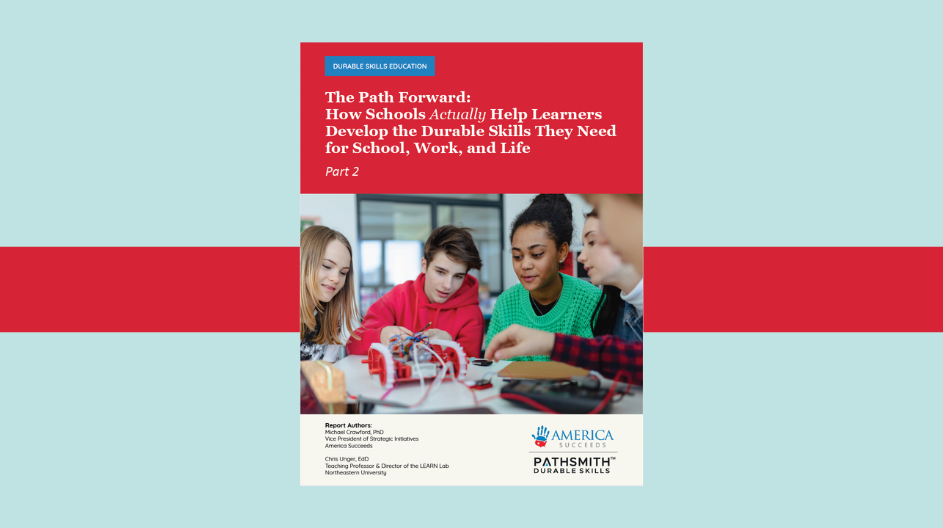
This is the finding from The Path Forward, America Succeeds’ 16-month study with twelve high schools and programs across nine states. We chose them precisely because they had nothing in common. The bet was simple: if we could find principles that worked across radical diversity, those principles would actually be real. Not artifacts of a budget, a region, a charter law, or a demographic. Real.
We found three.
Skills get named, not assumed. Every one of these schools defines, out loud, the capabilities they’re building, and shows students where they stand. Three tenets. Twenty competencies. Seven attributes. Four design phases. The frameworks look nothing alike on the surface, and they all do the same job: they make the invisible visible enough to develop on purpose. Once a student can name what she’s building, she can build it.
Stakes get real, not simulated. In every one of these schools, students do work that matters to someone other than the teacher who graded it. A press release that gets published. A wheelchair-accessible mascot costume that a child actually uses. A judicial decision that actually goes on a peer’s record. A song a client pays for. The audience is real. The consequences are real. So is the learning.
Skills organize the work, instead of getting bolted on. Content doesn’t disappear in these schools. Students master rigorous academic material, often at higher levels than peers in traditional schools. But content serves capability rather than the other way around. As one Da Vinci educator put it: we’re not teaching English and sneaking in some communication. We’re developing communication as the primary goal, and students learn literature, rhetoric, and grammar as tools that make it possible.
That’s it. Three principles. Twelve schools. Same kid.
The implication is the part most people don’t want to hear. If these principles produce the same outcomes in HSRA and Batesville and STEM School Chattanooga and One Stone, places that share absolutely nothing, then the reason your school isn’t producing them isn’t your students. It isn’t your budget. It isn’t your community. It’s whether you’ve decided to prioritize the work.
The full set of learnings is in The Path Forward report. The schools. The students. The evidence. Start there.